Your Logbook, With Data: Five U.S. Citizen Science Dives Worth Booking in 2026
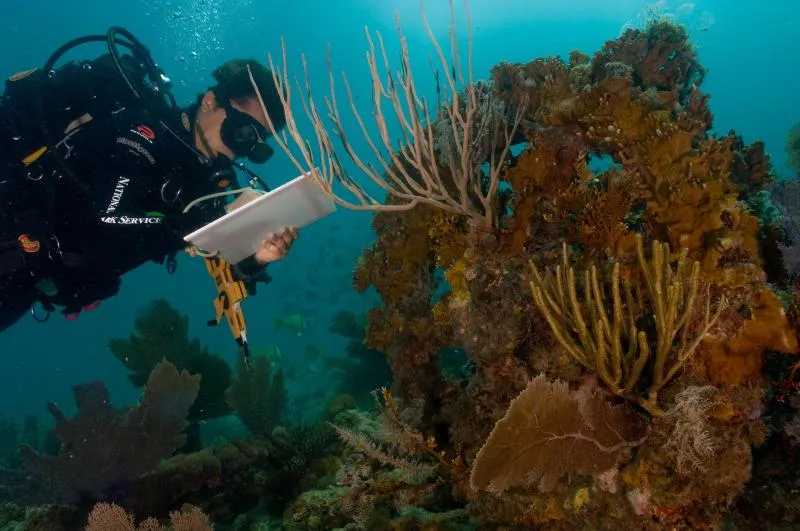
Photo: NPS Photo, Public domain, via Wikimedia Commons
There's a specific kind of dive that changes how the rest of your diving feels. You're on a reef you've seen a dozen times, but this time you're not just looking — you're counting, noting, and writing on a slate. You surface with a number. And that number goes somewhere.
Citizen science diving has been around long enough that it isn't a novelty anymore. In 2026 there are more ways than ever for a recreational diver in the U.S. to contribute, and a few well-worn programs that have been quietly building decades of data. Here are five worth planning a long weekend around.
First, the Unsexy Prerequisite
Be honest about your diving before you book anything. Survey work means hovering in one spot, holding a heading, and writing underwater. That requires solid buoyancy — better buoyancy than most vacation diving asks for. If you can't hold a position two feet off the bottom without touching anything, spend a season on that first. The reef will still need you next year.
What helps: Advanced Open Water, a buoyancy or peak performance specialty, Nitrox certification (more bottom time equals more survey time), and Rescue for anything involving boats or remote sites. Fish identification skills are learnable — most programs hand you the tools.
1. REEF Volunteer Fish Survey Project — Key Largo and Anywhere Else
The Reef Environmental Education Foundation has been collecting fish sighting data since the early 1990s, and its survey is the lowest-barrier entry point in the country. Train online with free fish ID quizzes, pass a Level 1 test, then survey any dive you want, anywhere in the world. Two divers, one slate, a list of species and abundance categories.
Where to start: REEF is headquartered in Key Largo, and the surrounding reefs are thick with survey sites. Field survey trips run through the year. If you want a reason to dive in July, the Great Annual Fish Count turns a whole month into a nationwide census.
Cost: essentially free beyond your normal boat fees.
2. Reef Check California — Kelp Forests From Monterey to San Diego
This one asks more of you, and it's worth it. Reef Check California runs a formal training course — classroom time plus checkout dives — then sends trained volunteers out on transects through kelp forests to count indicator species: giant kelp, sea urchins, abalone, and a list of fish. The data feeds into state-level management of California's marine protected areas.
Where to start: trainings are typically offered in spring along the Central Coast and in Southern California. Catalina Island and the Monterey Peninsula are both classic venues, and both reward a weekend beyond the survey itself.
Cost: a few hundred dollars for the course, plus boat fees. Plan on two days for the training alone.
3. Coral Restoration Dives — The Florida Keys
Restoration diving has exploded in popularity, which is both good and a little dangerous. The good version: you're working under a sanctuary permit, alongside staff, on nursery maintenance or outplanting, and your work is tracked in a restoration database. Several established operators and nonprofit programs in the Keys run volunteer and recreational restoration dives, often requiring an orientation or a restoration specialty first.
Where to start: Key Largo is the hub, and it's an easy add-on to a normal Keys trip.
A caution: if a shop offers to let you glue coral to a reef with no permit, no training, and no monitoring plan, walk away. Well-intentioned amateur planting can do real damage.
4. Lionfish Removals — Florida, the Gulf, and Beyond
Invasive lionfish aren't going anywhere, and removal is one of the few conservation activities where a recreational diver with a pole spear can make a measurable, immediate difference. Organized derbies and ongoing removal programs run throughout Florida and the Gulf, and state wildlife agencies have generally made removal easy by lifting bag and size limits for the species.
Where to start: the Florida Keys and the Gulf coast of Florida both host regular events. Expect to need solid buoyancy, a containment device, and some comfort with a pole spear. Check current state regulations before you go — gear rules shift.
Also: lionfish spines hurt. Gloves, and a plan for what happens if you get stuck.
5. Dive Against Debris — Anywhere, Including Your Local Lake
Not every meaningful survey is about fish. Debris surveys — item type, weight, material, entanglement risk — feed into a global database and give coastal managers hard numbers on what's actually washing up. The best part is access: you can run one off a beach, a pier, or a lake shore with a buddy and a mesh bag.
Where to start: shore dives and lake cleanups. This is the most beginner-friendly option on the list, and the most family-friendly if you want to bring along certified divers of mixed experience.
How to Vet a Project Before You Pay a Deposit
Ask these questions. The answers tell you most of what you need to know.
- Where does the data go? If the answer is a named database, a state agency, or a published paper, good. If it's a social media post, it isn't science.
- Is there a permit? Anything involving coral, protected species, or a sanctuary should have one.
- Is there training, or am I labor? Legitimate programs teach you the protocol. If you're just carrying things, that's fine — but call it what it is.
- What's the diver-to-staff ratio? Survey work with thirty untrained divers in the water produces noise, not data.
- Who owns what you collect? You should be comfortable with the answer.
Fitting It Into a Long Weekend
From most U.S. cities, the Florida Keys are the easiest version: fly into Miami or Fort Lauderdale on a Friday, drive an hour south to Key Largo, survey Saturday, fun dive or second survey Sunday, and fly home Monday afternoon. Remember the no-fly interval after your last dive and build it into the schedule rather than discovering it at the gate.
California takes a little more planning. Catalina is a ferry ride from Long Beach or San Pedro, which makes it a clean two-night trip. Reef Check training weekends often justify taking a Friday off.
The common thread across all five: you come home with a logbook entry that says something other than depth and time. That's a different kind of souvenir.