Your Brain on Depth: The Strange, Scary Science Behind Nitrogen Narcosis
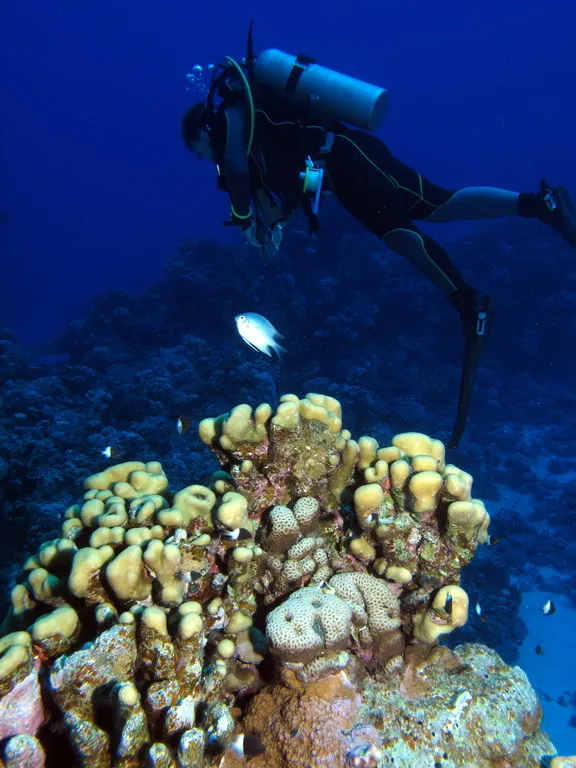
Photo: Derek Keats from Johannesburg, South Africa, CC BY 2.0, via Wikimedia Commons
There's a moment some divers describe that sounds almost poetic — a sudden sense of warmth, a loose, dreamy calm, the feeling that everything is perfectly fine even when it very much isn't. If that sounds appealing, here's the thing: it's your nervous system getting hijacked by physics, and it can get you killed.
Nitrogen narcosis is one of those diving topics that gets glossed over in open-water courses, usually filed somewhere between 'don't hold your breath' and 'equalize early.' But if you're pushing past 100 feet — or thinking about your advanced or divemaster certification — it deserves a lot more than a paragraph in a training manual.
Let's break down what's actually going on.
The 'Martini Effect' Is Real, But It's Not the Whole Story
You've probably heard the old rule of thumb: every 50 feet of depth equals roughly one martini on an empty stomach. It's a catchy way to explain narcosis, and it's not totally wrong — but it undersells how unpredictable the effect actually is.
Nitrogen narcosis occurs because nitrogen, which makes up about 78% of the air in your tank, becomes narcotic under pressure. As you descend, the partial pressure of nitrogen in your lungs increases. That nitrogen dissolves into your bloodstream and starts interfering with the transmission of signals between neurons — essentially, it disrupts the way your brain communicates with itself.
The physiological mechanism is similar to how anesthetic gases work. Researchers believe nitrogen affects lipid membranes in nerve cells, altering ion channel behavior and slowing neural conductivity. In plain terms: your brain starts lagging. Your reaction time slows. Your ability to assess risk degrades. Your emotional regulation takes a hit.
And here's the part that doesn't always make it into the dive briefing — the onset isn't linear. You might feel perfectly sharp at 90 feet and then hit a cognitive wall at 110 feet that you didn't see coming.
What Divers Actually Experience
The symptoms vary wildly from person to person, and even dive to dive for the same individual. Some divers report euphoria — a giddy, almost goofy sense of wellbeing. Others describe anxiety, paranoia, or tunnel vision. Some feel a strange detachment, like they're watching themselves dive from a slight distance. A few report auditory or visual distortions.
One diver we spoke with, a certified rescue diver with over 200 logged dives, described her first serious narcosis episode during a wall dive off the Florida Keys:
'I was at about 120 feet and I just... stopped caring about my air. I remember looking at my gauge and thinking the number didn't really apply to me. My buddy had to physically turn me around. I had no memory of deciding to stay down.'
That last part — the failure of decision-making — is the most dangerous aspect of narcosis. It's not just that you feel weird. It's that your judgment about whether you feel weird gets compromised at the same time. The impairment is self-concealing.
Another common experience is fixation. Divers get absorbed by something — a fish, a crack in the wall, their own hand — and lose situational awareness entirely. Minutes pass. Air depletes. Buddies drift out of sight.
Depth Isn't the Only Variable
Here's something a lot of intermediate divers don't realize: depth triggers narcosis, but several other factors can make it significantly worse.
Cold water accelerates the effect. Your body under thermal stress is already working harder, and that physiological load seems to lower the threshold at which narcosis sets in.
Anxiety and fatigue compound the impairment. A diver who's already nervous or tired going into a deep dive is going to feel the effects sooner and more intensely.
Carbon dioxide buildup, which can happen when divers skip-breathe (a bad habit some people develop trying to conserve air), dramatically increases narcosis susceptibility. CO2 is itself a mild narcotic, and the combination is not friendly.
Alcohol and certain medications — even ones taken the day before — can lower your resistance. This is one reason that 'just one beer with dinner' rule before diving isn't just about coordination.
Can You Train Your Way Out of It?
Short answer: sort of. You can't eliminate narcosis — the physics don't care how experienced you are. But you can build familiarity with your own symptoms and develop mental strategies that help you function through it.
This is a big part of what PADI's Deep Diver specialty and technical diving courses address. The goal isn't to make narcosis disappear; it's to make divers aware of their personal narcosis profile and give them tools to self-monitor and self-correct.
Practical techniques include:
- Descent rate management: Slowing your descent gives your nervous system more time to adjust incrementally.
- Pre-dive cognitive benchmarks: Some instructors have students memorize a short number sequence before descending and repeat it at depth to check their own clarity.
- Buddy check protocols: Establishing specific non-verbal signals for 'I'm feeling off' before the dive, so communication doesn't rely on impaired judgment.
- Controlled exposure: Building experience at progressively deeper depths — with a qualified guide — so you understand your personal threshold before you're tested by conditions.
At Delfin Diving, our advanced guided dives include pre-dive briefings that specifically walk through narcosis awareness. It's not about scaring anyone off depth — it's about making sure that when the ocean gets interesting, you stay sharp enough to enjoy it.
The Bottom Line on Going Deep
Nitrogen narcosis isn't a reason to avoid deep diving. It's a reason to approach it with the right education, the right buddy, and the right guide. The divers who get into trouble are usually the ones who underestimated it — who assumed their experience level made them immune, or who pushed past their training without building the situational awareness that depth demands.
The physics of pressure don't negotiate. But the more you understand what's happening in your body at depth, the better equipped you are to work with it instead of against it.
If you're thinking about taking your diving to the next level, that education starts before you ever hit the water. And that's exactly the kind of conversation we love having.