From Frozen to Fearless: A Diver's Guide to Conquering Underwater Anxiety
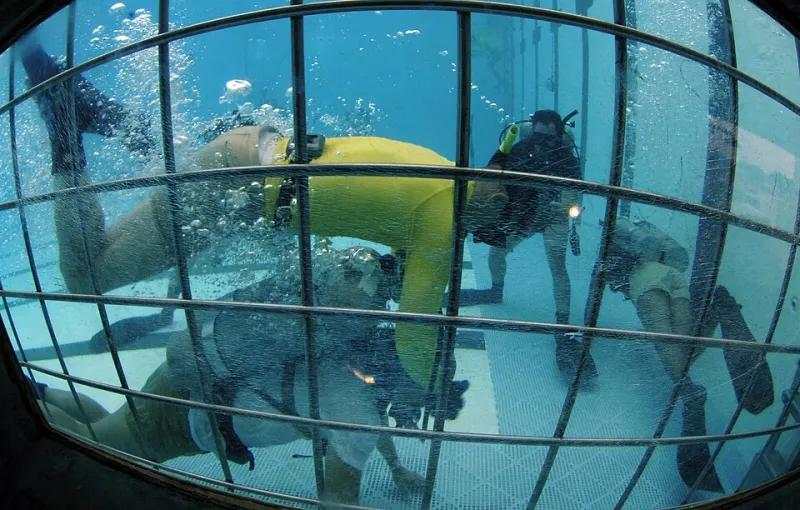
Photo: U.S. Navy photo by Mass Communication Specialist 2nd Class Jayme Pastoric, Public domain, via Wikimedia Commons
You passed your open water course. You logged your checkout dives. You bought the gear, maybe even the wetsuit that fits a little too well. And then... you stopped going. Sound familiar?
For a surprising number of certified divers, anxiety is the invisible anchor keeping them on the surface. It doesn't always look dramatic — it's not always a full-blown panic attack at 60 feet. Sometimes it's just a low hum of dread in the days before a dive trip, or that weird hesitation right before you roll backward off the boat. Whatever shape it takes, underwater fear is real, it's valid, and — here's the good news — it's absolutely workable.
Why the Underwater Environment Messes With Your Head
Humans weren't built for the deep. Every instinct we have screams that breathing underwater is wrong, that limited visibility is dangerous, and that being surrounded by an alien environment with no quick exit is a threat. The brain doesn't much care that you've got a regulator in your mouth and a dive buddy three feet away. It still fires off the same alarm bells it would if you were genuinely in danger.
Sports psychologists who work with divers and other extreme sports athletes call this a "threat-appraisal mismatch" — your rational mind knows you're safe, but your nervous system hasn't gotten the memo. The result is elevated heart rate, shallow breathing, tunnel vision, and sometimes a complete freeze response. In diving, that freeze can cause real problems: breath-holding, rapid ascents, or abandoning a dive entirely.
The key insight? Fear underwater isn't a character flaw. It's a neurological response that can be retrained.
The Breathing Loop Nobody Talks About
Here's something dive instructors will tell you off the record: most panic spirals start with breathing, not the other way around. When anxiety kicks in, divers unconsciously begin to breathe faster and shallower. That increases CO2 in the bloodstream, which signals the brain that something is very wrong, which ramps up anxiety further — and suddenly you're bolting for the surface from 40 feet.
Breaking that loop is the single most powerful tool in your mental toolkit. The technique that keeps coming up among experienced instructors is something close to what's called "box breathing" in clinical settings: inhale for four counts, hold for four, exhale for four, hold for four. It sounds almost too simple, but it works because it gives your prefrontal cortex something concrete to do, which pulls cognitive resources away from the panic response.
Practice it on land first — in the shower, before bed, during your commute. The goal is to make it automatic enough that you can deploy it the moment you feel that first flutter of anxiety under the surface.
Building a Confidence Ladder
One of the biggest mistakes anxious divers make is trying to "exposure therapy" themselves by jumping straight into challenging conditions. You don't conquer a fear of deep water by immediately booking a 100-foot wreck dive. You build confidence incrementally, and each small win genuinely rewires your threat-appraisal system over time.
Dive instructors who specialize in working with nervous divers often recommend what they call a "confidence ladder" — a personalized progression of small, achievable challenges. It might look something like this:
- Rung 1: Gear up and breathe through your regulator while sitting in the shallows, feet still touching the bottom.
- Rung 2: Float face-down in chest-deep water and practice slow, controlled breathing for two minutes.
- Rung 3: Descend to 15 feet in a pool or calm, clear water with a trusted buddy. No agenda. Just exist down there.
- Rung 4: Repeat that shallow dive until it feels genuinely boring.
- Rung 5: Add a simple task — a buoyancy drill, a navigation exercise — so your brain has something to focus on besides the anxiety.
The specifics will look different for everyone, but the principle is the same: never push past the point where anxiety becomes panic. Growth happens in the uncomfortable-but-manageable zone, not in the terrifying one.
What Experienced Divers Actually Do When Things Feel Wrong
There's a mental habit common among experienced divers that beginners rarely get taught: the deliberate pause. When something feels off — gear, visibility, depth, a weird sensation — seasoned divers don't react immediately. They stop, hover neutrally, and run a quick internal scan. Is this an actual problem, or is it anxiety talking? What's the specific thing that feels wrong? What's the simplest fix?
This three-second pause interrupts the panic loop before it gains momentum. It also gives your dive buddy a visual cue that you're checking in with yourself, which is infinitely better than a sudden ascent that catches everyone off guard.
Coupling that pause with a deliberate signal to your buddy — even just a "checking in" hand gesture you've agreed on beforehand — turns a private anxiety moment into a shared, manageable one.
The Role of Visualization (Yes, Really)
Elite athletes in every sport use mental rehearsal, and there's solid research behind why it works. For divers, a simple five-minute visualization practice before a dive can meaningfully reduce anxiety responses underwater.
The night before a dive, sit somewhere quiet and walk through the entire experience in your mind: gearing up, the giant stride or backward roll, the descent, the bottom time, the ascent. Picture it going smoothly. Feel the buoyancy, the quiet, the light filtering through the water. If your mind wanders to a worst-case scenario, gently redirect it. You're not pretending problems don't exist — you're training your brain to default to calm competence rather than catastrophe.
When to Get More Help
Sometimes anxiety around diving is connected to broader patterns — claustrophobia, post-traumatic stress, generalized anxiety disorder — that benefit from working with a professional. There's no shame in that. A few sessions with a sports psychologist or therapist who understands performance anxiety can do more than months of white-knuckling it through dives.
If you've had a genuinely scary incident underwater — a near-miss, equipment failure, a dive that went badly — consider a structured "return to diving" program with a patient, experienced instructor before getting back in on your own. Many dive shops, including the team here at Delfin Diving, can connect you with instructors who specialize in exactly this kind of confidence rebuilding.
The Water Is Still Waiting
Fear doesn't mean you're not a diver. It means you're human. The ocean rewards patience and self-awareness more than bravado, and the divers who do the internal work tend to become the most capable, most present, most genuinely joyful people underwater.
Dive deeper — but start wherever you are.