What the Deep End Does to You: The Science and Soul of Diving as a Wellness Practice
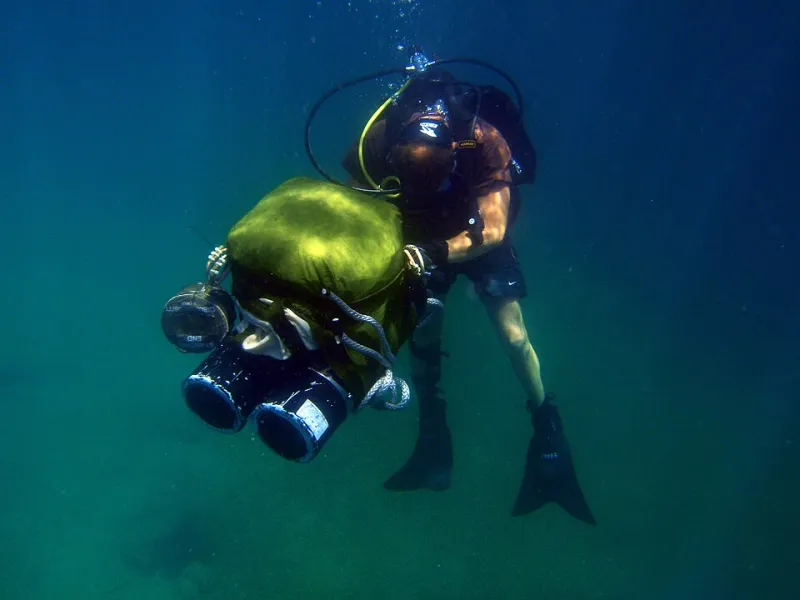
Photo: U.S. Navy photo by Mass Communication Specialist 1st Class Joseph W. Pfaff, Public domain, via Wikimedia Commons
Ask almost any experienced diver why they keep going back, and you'll eventually get past the stock answers — the colors, the fish, the freedom — and land on something harder to articulate. Something about the way the world feels different after a dive. Quieter. More manageable. Like whatever was knotted up inside you got gently loosened by the pressure and the blue.
That feeling isn't just poetic. There's real science behind it. And as mental health professionals increasingly explore non-traditional wellness interventions, recreational scuba diving is starting to attract serious attention.
Your Body on the Descent
The moment you drop below the surface and equalize for the first time, your body begins a series of adaptations that have no real equivalent on land.
The most immediate is the mammalian dive reflex — an evolutionary response that humans share with marine mammals. As your face enters cold water and pressure increases, your heart rate slows, blood flow is redistributed away from your extremities toward your core organs, and your spleen contracts slightly, releasing a surge of oxygenated red blood cells into your bloodstream. The body, in essence, shifts into a different mode of operation. A more efficient, more conserved mode.
At depth, the increased partial pressure of oxygen has a mild vasodilatory effect, slightly widening blood vessels and creating a sensation of warmth and ease that many divers describe as almost sedative. The weight of the water column above you creates a gentle, full-body compression — not unlike the science behind weighted blankets, which are used therapeutically for anxiety and sensory processing disorders.
Breathing slows. Heart rate drops. The nervous system, flooded with sensory input from an unfamiliar environment, has no bandwidth left for the usual mental noise.
The Neuroscience of Silence
Dr. Wallace J. Nichols, a marine biologist and author of Blue Mind, has spent years studying what he calls the "blue mind state" — a mildly meditative, neurologically distinct condition that humans enter when near, in, or underwater. His research draws on neuroimaging studies suggesting that aquatic environments shift the brain from high-alert, task-focused activity centered in the prefrontal cortex toward the default mode network — the same neural system activated during meditation, creative thinking, and psychological integration.
For divers, this effect is amplified by the demands of the environment itself. You cannot check your phone at 60 feet. You cannot replay an argument from last week while managing your buoyancy and watching your air. The ocean imposes a radical form of presence that most people spend years trying to cultivate through meditation practice — and it delivers it more or less automatically.
Certified diver and former Marine Marcus T., who learned to dive after returning from two deployments overseas, described it this way: "The first time I went below 40 feet, something just... stopped. All the stuff that was running in the background of my brain, the vigilance, the scanning — it was still there, but it had something real to do. I was actually using it. And when I came up, it was like I'd hit a reset button."
Marcus isn't alone. Veterans' organizations across the United States, including programs affiliated with the Wounded Warrior Project, have begun incorporating scuba diving into PTSD recovery protocols, with early results showing measurable reductions in hyperarousal symptoms and improvements in sleep quality.
Depth as a Mirror
There's a psychological dimension to depth that goes beyond neuroscience. The experience of descending — of leaving the surface, of moving away from the familiar world above — has a metaphorical weight that most divers feel viscerally even if they've never put words to it.
Shallow dives, in the 15 to 40-foot range, tend to feel connected to the surface world. Light penetrates easily, you can look up and see the hull of the boat, the reef is bright and busy. These are social dives, accessible dives, dives that feel like an extension of the vacation.
But push past 60 feet and something shifts. Colors begin to drop out of the spectrum — reds and oranges disappear first, leaving a world of blues and greens. The surface becomes a distant shimmer. The soundscape changes. You're no longer visiting the ocean; you're inside it in a different way.
At 80 or 100 feet, recreational divers often report a distinct quality of solitude — even in a group — and a heightened sense of their own smallness that many describe not as frightening but as relieving. The problems that felt enormous at the surface have, for the moment, accurate scale.
Sarah K., a therapist based in San Diego who has been diving for eleven years, puts it bluntly: "I've had more genuine perspective shifts at depth than in years of my own therapy. There's something about being in an environment that is completely indifferent to your ego that just cuts through a lot of the noise."
The Long Game: Diving and Long-Term Resilience
The wellness benefits of diving don't stay underwater. Studies on regular aquatic exercise and mindfulness-based interventions consistently show that practices which build present-moment awareness and physical regulation — both of which diving demands — have lasting effects on anxiety, depression, and stress resilience.
Divers who log consistent time in the water tend to develop what psychologists call interoceptive awareness — the ability to accurately read and regulate your own body's internal signals. Managing buoyancy, monitoring your breathing, equalizing on cue: these are all exercises in body attunement, and that skill transfers topside.
There's also the community dimension. Diving is inherently a buddy sport. The dive community in the US — from the Florida Keys to the Pacific Northwest — is one of the more genuinely welcoming subcultures in outdoor recreation, built around shared experience and mutual reliance. Connection to a community with shared values and regular, meaningful ritual is one of the most consistently cited factors in long-term psychological wellbeing.
Dive Deeper — In Every Sense
At Delfin Diving, we've always believed that the ocean gives back more than the dive logs can capture. The certifications matter, the destinations matter, the marine life absolutely matters — but what keeps people coming back, year after year, dive after dive, is something the underwater world does to the inside of a person.
It quiets things. It scales things. It reminds you, in the most physical and immediate way possible, that you are a temporary visitor in a vast and largely indifferent system — and somehow, that reminder feels like the deepest breath you've taken all year.
If you've been thinking about getting certified, or about finally planning that trip to a site that's been on your list, consider this: you might not just be booking a vacation. You might be investing in something your nervous system has been asking for longer than you realize.