After Dark, Off the Wall: Blackwater Diving Comes Home to U.S. Waters
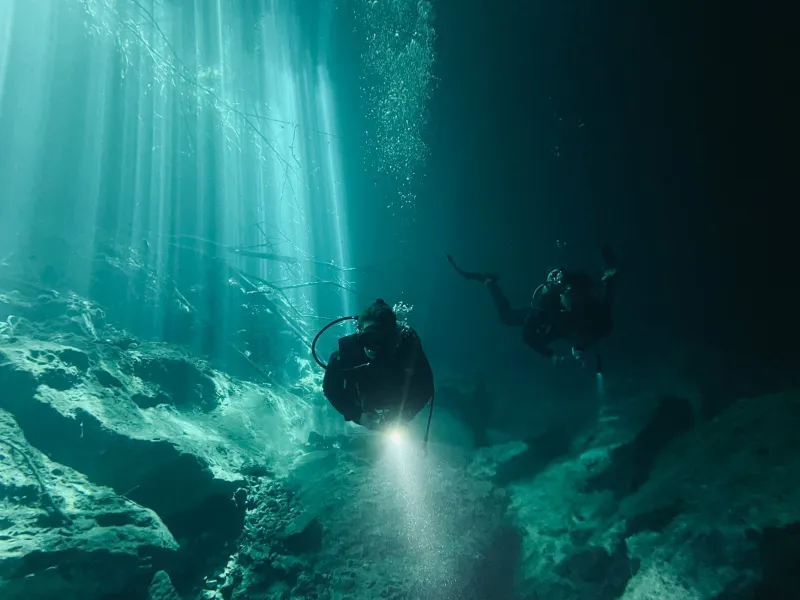
On a blackwater dive, the boat does not tie up to a reef. It idles over water deep enough to hide a small mountain, the divemaster drops a weighted line with lights, and a handful of divers slips into the dark. There is no bottom in the usual sense. There is no wall, no coral head, no wreck to orient you. There is just blue-black water, a glow stick, and whatever swims up from the deep.
That sounds like a stunt. It is not. Blackwater diving is one of the fastest-growing specialty nights in recreational diving, and in 2026 it is no longer a Pacific-only bucket-list item. U.S. divers can find guided blackwater trips off Florida, Hawaii, and Southern California—closer, cheaper, and every bit as strange.
What Blackwater Actually Is
A standard night dive gives you a reef lit by your torch, with the comfort of a known site underneath you. A blackwater dive gives you open ocean after sunset, usually over hundreds or thousands of feet of water. The boat hangs a downline with lights attached, and divers hold a position near it while tiny deep-water animals rise toward the surface. This is the vertical migration: lanternfish, squid, shrimp, jellyfish, and larvae that spend their days in the dark and their nights closer to the moon.
The result feels less like a reef dive and more like a planetarium with fins. Creatures appear out of nowhere, pulse once, and vanish. Your light catches an eye, a ribbon, a transparent body no bigger than a fingernail. You are not touring a site. You are hovering in a moving neighborhood.
Why It Is Showing Up on U.S. Boats
Hawaii has been the American gateway for years, especially off Kona, where the deep water sits close to shore. But Florida operators have been building blackwater trips into their winter and summer schedules, using the Gulf Stream to drift over serious depth. Southern California boats have their own version, trading warm water for cooler conditions and a different cast of characters.
For U.S. divers, the appeal is obvious. You do not need a passport, a liveaboard crossing, or a two-week leave request. You need a boat, a buddy, a primary light that behaves, and a divemaster who has run the line before. That accessibility is exactly why the dive is moving from niche curiosity to trip-planning conversation.
The Skills Tax
Blackwater is not a harder dive because it is deep. Most profiles stay within recreational limits. It is harder because it removes your references. There is no reef to gauge your position, no sand to land on, no coral head to push off. If your buoyancy depends on looking down, this dive will find you out.
Good blackwater divers hold a narrow depth band without constant correction. They keep their trim flat, keep their light steady, and keep one hand free enough to signal. They also manage task loading well: light, line, buddy, camera, brain. The dive asks you to be still in a place that feels anything but still.
Gear That Earns Its Space
A bright primary light is the obvious starting point, but bring a backup. Blackwater is no place to discover that your only torch has decided to take the night off. A tank light or small marker light helps your buddy find you. A glow stick on your tank is old-school and still useful. Gloves are a personal call, but they can help with line handling in cooler water.
Leave the camera in the bag until you have done a few blackwater dives. Photography here is a task-loading multiplier. The animals are small, fast, and unpredictable. Your first trip is for your eyes, not your memory card.
Safety Protocols Are the Whole Point
The briefing is not a suggestion. It is the dive plan. Listen for the maximum depth, the hang time, the line protocol, the light signals, and the recall signal. Stay close enough to your buddy to matter. Do not chase a squid into the dark. Do not ascend alone because you saw something interesting. The downline is not a leash, but it is a reference, and on a blackwater dive, references are currency.
Most operators run a headcount before and after, keep the boat lit, and brief the current. If the current is ripping or the weather is marginal, the best call is often to dive another day. The open ocean does not owe you a sighting.
How to Know You Are Ready
There is no magic number, but comfort matters more than count. If you are solid on night dives, relaxed in low visibility, and honest about your buoyancy, you are in the conversation. If you still chase the bottom for orientation or need a reef to feel safe, give it time. A guided blackwater intro is a better first step than a full send.
Blackwater is not for every diver. That is part of the appeal. It is a reminder that diving is not always about looking down at a site. Sometimes it is about hanging in the dark, holding your position, and letting the ocean come to you.