Rust, History, and the Perfect Dive: Why Wreck Diving Has Become America's Favorite Underwater Obsession
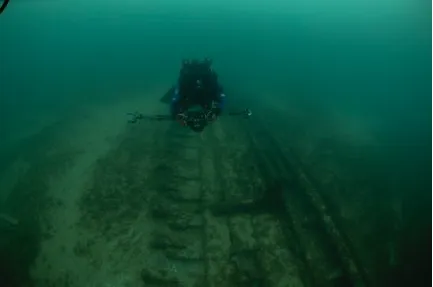
Photo: National Oceanic and Atmospheric Administration photo, Public domain, via Wikimedia Commons
At some point on almost every dive trip, someone brings up wrecks. Maybe it's the guy at the dive shop in Key Largo who casually mentions the Spiegel Grove like it's a local legend (it is). Maybe it's the couple on the liveaboard who spent last summer working through every accessible wreck off the North Carolina coast. Wherever divers gather, wrecks come up—and more and more often, they're the whole point of the trip.
Wreck diving has had a serious moment over the past several years in the US, and it doesn't look like a trend that's fading. Dive operators are reporting increased demand for wreck-specific excursions. Certifications in wreck diving specialty courses have climbed steadily. Online communities dedicated to wreck exploration have grown substantially. Something about sunken vessels captures the diver's imagination in a way that's hard to fully explain—but worth trying.
What Makes Wrecks Different from Everything Else
Reef diving is beautiful. Drift diving is exhilarating. Cave diving is technically demanding in its own right. But wreck diving occupies a unique category because it combines almost everything that draws people to scuba in the first place: history, mystery, technical challenge, and marine life, all wrapped up in a single dive site.
Every wreck has a story. That's not a cliché—it's the literal truth. When you descend onto a World War II freighter off the coast of North Carolina or drop down to a deliberately sunk Navy vessel in the Florida Keys, you're swimming through an artifact. The ship had a crew. It had a purpose. It traveled routes and carried cargo and, at some specific moment in time, it ended up on the bottom. That context transforms the experience from a dive into something closer to a visit.
There's also the biological dimension. Shipwrecks become artificial reefs remarkably fast. Hard surfaces attract invertebrates, which attract fish, which attract larger predators. A wreck that's been on the bottom for a few decades is typically teeming with life in a way that can rival any natural reef—and the juxtaposition of marine biology against man-made structure creates a visual experience that's genuinely unlike anything else underwater.
America's Wreck Diving Landscape Is Extraordinary
The United States is quietly one of the best wreck diving destinations in the world, and most people outside the diving community have no idea. The geography and history conspired to put an astonishing number of significant wrecks within recreational reach of American divers.
The Graveyard of the Atlantic off North Carolina's Outer Banks is probably the most famous American wreck diving region. During World War II, German U-boats sank dozens of Allied ships in these waters. The USCGC Cutter Spar, the USS Schurz, the tanker Aeolus—these are just a few of the accessible sites where history sits in clear, diveable water. The area around Morehead City and Beaufort has built an entire dive tourism economy around these wrecks.
South Florida and the Keys offer a different flavor. The artificial reef program here has deliberately sunk decommissioned ships to create dive sites, including the famous USS Vandenberg near Key West—one of the largest artificial reefs in the world—and the aforementioned Spiegel Grove near Key Largo. These are accessible, well-documented, and regularly dived, which makes them excellent entry points for wreck beginners.
The Great Lakes are an entirely different world. Cold, fresh water and low visibility might sound unappealing, but those same conditions preserve wooden wrecks extraordinarily well. Some Great Lakes shipwrecks date back to the 19th century and remain remarkably intact. For divers interested in maritime history, this region is genuinely unmatched.
On the West Coast, the Channel Islands off Southern California hold wrecks ranging from 19th-century sailing vessels to more recent losses, all set against dramatic underwater terrain.
The Skills You Actually Need
Here's where wreck diving diverges from recreational reef diving, and it's worth being honest about the gap. Casual wreck diving—swimming around the exterior of a sunken vessel, observing the structure without penetrating it—is accessible to any certified open-water diver with decent buoyancy control. If you can hover without kicking up silt and you're comfortable with your navigation, you can enjoy the outside of most recreational wrecks.
Penetration diving is a different matter entirely. Entering a wreck—going inside the structure, moving through corridors and compartments—introduces hazards that simply don't exist on open-water dives. Silt can be disturbed and visibility can drop to zero in seconds. Disorientation is a real risk. Exit routes can become confusing. And unlike open-water problems, you can't simply ascend to resolve an emergency.
This is why PADI's Wreck Diver specialty certification exists, and why it's genuinely worth pursuing before you start talking about going inside anything. The course covers penetration techniques, line laying, light requirements, emergency protocols, and the mental discipline required to stay calm when the environment gets tight and dark. It's not just a credential—it's a framework for thinking about wreck environments that changes how you dive them.
Beyond certification, buoyancy mastery is non-negotiable. Wreck interiors are often silty, and a diver with sloppy fin kicks can reduce visibility to zero for everyone in seconds. If you're still working on buoyancy control, spend time on that before you commit to penetration dives.
Is Wreck Diving Right for You?
The honest answer is: probably yes, but it depends on what draws you to it and where you're starting from.
If you're motivated by the historical and biological richness of the sites, you can start enjoying wreck diving at almost any certification level by sticking to exterior dives. There's tremendous value in simply being present on a significant wreck—you don't have to go inside to appreciate what you're looking at.
If you're drawn to the technical challenge and the idea of penetration diving, that's a legitimate and rewarding path—but it requires honest self-assessment about your current skill level and a commitment to proper training. Rushing into penetration dives without the right background is one of the more reliable ways to get into serious trouble underwater.
And if you're not sure yet? That's actually the ideal starting point. Book a guided dive on an accessible wreck—something like the Spiegel Grove or any of the Outer Banks sites—and see how you respond to the environment. A lot of divers discover that wrecks resonate with them in a way they didn't anticipate. Others find that they prefer open water and living reefs, and that's completely valid too.
The Wreck Diver's Mindset
What distinguishes serious wreck divers isn't just skill—it's a particular kind of curiosity. They tend to research sites before they visit them. They want to know the ship's history, its dimensions, what they're likely to find at various depths. They think about light and silt and navigation before they ever hit the water. That preparation isn't just safety-oriented; it makes the dive richer.
If that kind of deliberate, layered approach to underwater exploration appeals to you, wreck diving might be exactly the direction your diving should go next. The sites are out there—more of them than most people realize—and the history sitting on the bottom of American waters is waiting for divers curious enough to go find it.