Chum in the Water, Elephant in the Room: The Real Story Behind Florida's Baited Shark Dives
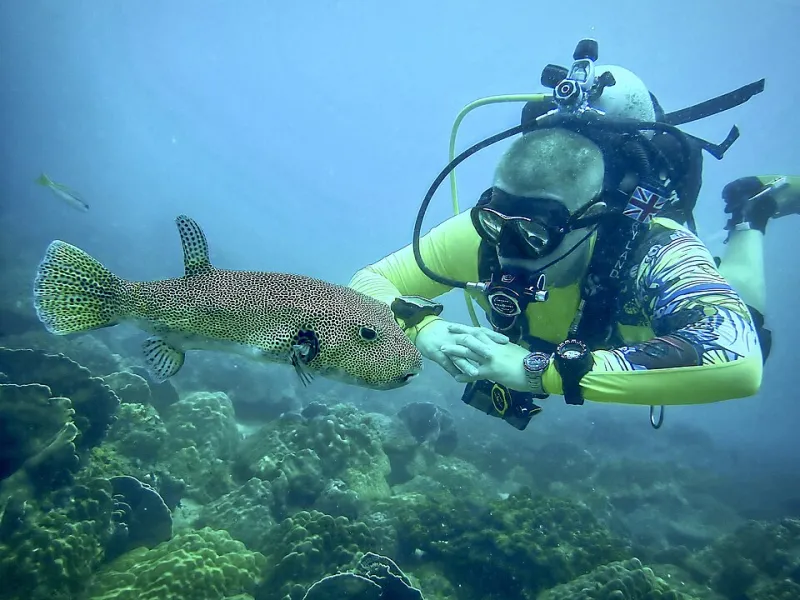
Photo: Ryland.cairns, CC0, via Wikimedia Commons
There's a moment on every baited shark dive — usually about ninety seconds after you settle onto the sand at 80 feet — when the water changes. The reef goes quiet. The snapper scatter. And then a silhouette appears at the edge of the blue, wide as a garage door, moving like it has nowhere in particular to be.
That's when you understand why people fly across the country for this.
Off Jupiter, Florida, a stretch of Gulf Stream-fed water about ninety minutes north of Miami, a handful of operators run what the industry calls "baited shark dives." A crate of fish scraps hangs in the water column, drawing in lemon sharks, Caribbean reef sharks, and — if the season is right — a tiger shark the size of a pickup truck. No cage. Just you, your buddy, and a whole lot of apex predator.
It's one of the most thrilling dives in the United States. It's also one of the most debated. So before you hand over your deposit, here's the honest breakdown.
What the Dive Actually Looks Like
Despite the postcard version, nobody is wrestling sharks or hand-feeding them for selfies. Reputable Jupiter operations follow a pretty standardized format: divers descend to a designated sandy bottom site, kneel or hover in a tight group behind the divemaster, and stay put while a bait crate — usually frozen chum and fish carcasses — does the attracting from a distance.
The sharks aren't being fed so much as being interested. Most never take the bait. They circle, investigate, and move on. Encounters typically last 30 to 45 minutes, and the divemaster carries a pole or billy to redirect any animal that gets too curious — which, on well-run boats, is rare.
Jupiter's star attraction is the lemon shark in winter, with tiger sharks making cameo appearances from late fall through early spring. Silky and sandbar sharks show up too. Visibility is often 80 feet or better thanks to that warm Gulf Stream current, which is also why the water feels surprisingly tropical for a site that's technically the same latitude as Houston.
The Safety Record Is Better Than You'd Think
Here's the part that surprises people: the injury record for professionally run baited dives is remarkably clean. Millions of baited shark dives have been conducted worldwide — Florida, the Bahamas, Mexico, Fiji — and serious incidents involving trained operators are vanishingly rare.
Why? Because these aren't improvised encounters. Good operators brief exhaustively, enforce strict positioning, cap diver numbers, and screen out anyone who can't hold their position and manage their buoyancy. The dangerous variable isn't the shark. It's a diver who panics, drifts into the bait zone, or bolts for the surface.
That's your homework, not the shark's: ask how many divers they take per trip, how long they've been operating, and what their briefing covers. If the answer to any of those is vague, book somewhere else.
The Ethical Debate — Taken Seriously
Now for the elephant — or rather, the chum — in the room. Critics of baited dives raise three legitimate concerns, and anyone telling you they're all settled is selling something.
Conditioning. Does repeatedly associating divers (or boats) with food change shark behavior? Research so far suggests the effect is localized and temporary — sharks learn that a specific site at a specific time means a snack, not that every boat is a buffet. But studies are ongoing, and honest operators will admit the science isn't fully closed.
Altered feeding and movement. Some researchers worry that regular baiting could shift shark activity patterns or diet. The counterpoint: the volume of food is tiny compared to a shark's natural intake, and many operations are moving toward smaller, less frequent bait deployments.
The conservation math. This is where the argument tips, even many skeptics concede. Sharks are being slaughtered globally at a staggering rate, largely for fins. A diver who has locked eyes with a lemon shark becomes, statistically, a person who votes for shark protection, donates to research, and tells everyone at the office party why sharks matter. Florida's shark fishing regulations have strengthened alongside the growth of its dive tourism, and plenty of operators fund tagging programs and citizen-science photo ID projects on the very trips they sell.
Is that a perfect justification? No. Is it nothing? Also no. It's a trade-off, and reasonable people land in different places on it.
Who Should (and Shouldn't) Book One
Be honest with yourself about your skills. These dives happen in blue water with current, often at depth, with a lot of visual stimulation. You need solid buoyancy control, comfort hovering near the bottom without stirring sand into everyone's photos, and the ability to stay calm when a 10-foot tiger shark turns toward you — which it will, briefly, before losing interest.
If you're freshly open-water certified, consider building up a few dozen dives first. Plenty of operators require 25 or more, and that's not gatekeeping — it's physics and nerves.
How to Do It Right
- Go in winter. December through March is peak season for Jupiter's lemon and tiger sharks, and the cooler water means thicker wetsuits — which, conveniently, also mean more protection and better trim.
- Pick an operator with a conservation tie-in. The best boats partner with researchers, log every sighting, and will happily explain their baiting practices over the phone.
- Leave the GoPro heroics at home. The divers who cause problems are the ones chasing shots. Set your camera, hold your position, and let the sharks come to you. They will.
- Ask about the no-touch, no-chase policy. Every credible operation has one, in writing.
The Verdict From the Water
Every diver we've talked to who's done a Jupiter shark dive says some version of the same thing: it changed how I see them. Fear becomes fascination. Fascination becomes advocacy. That transformation is happening 80 feet down, one kneeler at a time, and it's hard to argue the ocean is worse off for it.
The sharks were there first. The question isn't really whether we should visit — it's whether we can do it in a way that leaves them better protected than we found them. Off Jupiter, right now, the answer looks a lot like yes.