What Happens to Your Mind When You Swim Next to a Dolphin
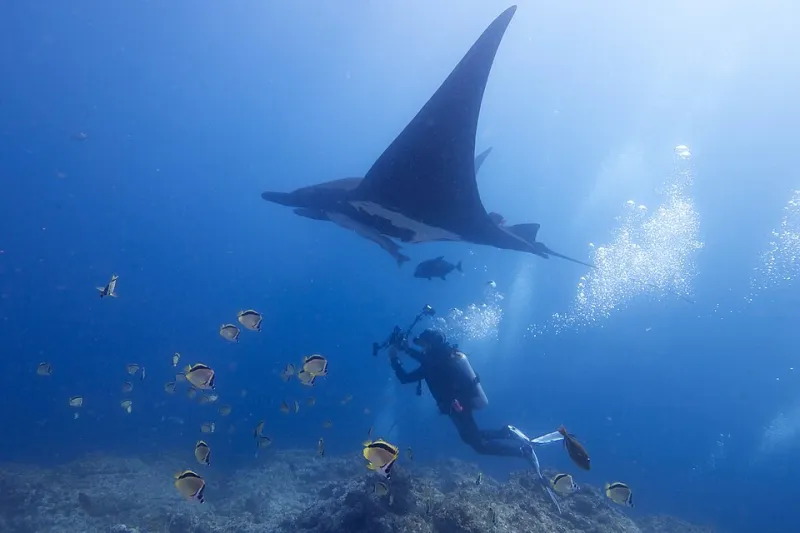
Photo: Elias Levy, CC BY 2.0, via Wikimedia Commons
You've probably heard divers try to describe it. They fumble for words, laugh a little, trail off mid-sentence. "It's just... different," they say. "I can't really explain it." And honestly? That's not just poetic vagueness. What happens in your brain during a close encounter with a wild dolphin or a curious whale shark is genuinely hard to put into language — because it's operating on a level that language doesn't fully reach.
But science is getting closer to explaining it. And what researchers are finding is fascinating, a little humbling, and more than a little relevant to why so many divers describe these moments as genuinely life-changing.
Your Brain on Eye Contact — Even Underwater
Humans are wired for social connection, and a big part of that wiring runs through eye contact. When you make sustained eye contact with another being — particularly one that returns the gaze with apparent curiosity — your brain releases a cocktail of neurochemicals, including oxytocin (sometimes called the "bonding hormone"), dopamine, and serotonin. Studies on human-animal interaction, particularly with dogs and great apes, have confirmed this response. Dolphins, with their highly developed social intelligence and reputation for deliberate engagement with humans, appear to trigger a similar reaction.
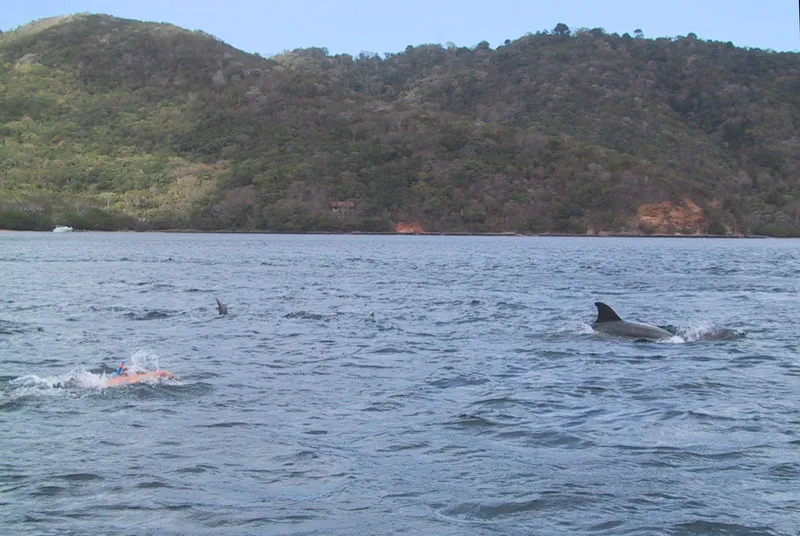
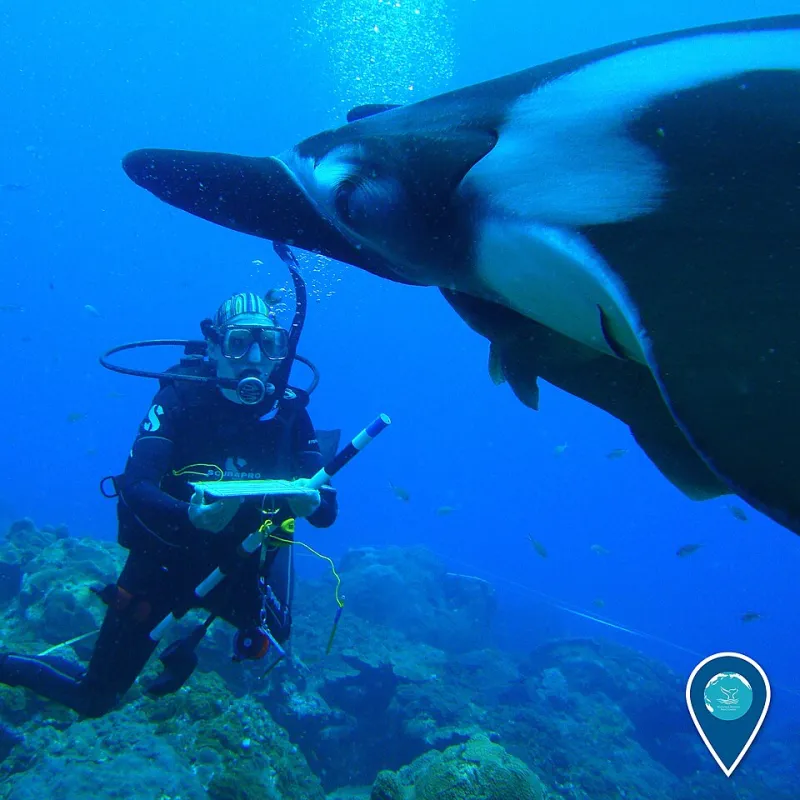
Now add the underwater environment. You're already in a mild altered state — controlled breathing slows your nervous system, the sensory input is dramatically different from anything on land, and your body is weightless. That baseline neurological shift makes you more receptive, more present, and more emotionally open. When a bottlenose dolphin banks toward you, makes eye contact, and holds it for a few seconds before gliding away, your brain isn't just processing "cool animal." It's processing a moment of genuine cross-species recognition, and that hits differently.
The Memory Imprint: Why These Moments Stick
Ask almost any experienced diver about their most memorable dive, and there's a good chance it involves a marine mammal. That's not a coincidence — it's neurobiology.
The amygdala, your brain's emotional processing center, tags memories with emotional weight. The more emotionally activated you are during an experience, the more vividly and durably the memory is encoded. Encounters with intelligent marine life tend to trigger high-arousal emotional states — wonder, joy, a little awe, sometimes even a touch of healthy fear — which means those moments get burned into long-term memory with unusual clarity.
This is why divers who swam with wild spinner dolphins off the Kona coast in 2009 can still tell you exactly what the light looked like, how the animals moved, what they felt in their chest. The amygdala was doing its job, and it did it well.
Conservation Mindset: The Behavioral Ripple Effect
Here's where it gets really interesting — and really relevant if you care about the ocean.
Research in environmental psychology has consistently found that direct, emotionally resonant experiences with wildlife are among the strongest predictors of pro-conservation behavior. Not documentaries. Not statistics. Not even guilt. Actual, in-person encounters where something wild looks back at you.
Divers who've had meaningful encounters with marine mammals report measurably higher rates of conservation-oriented behavior afterward: donating to ocean nonprofits, reducing single-use plastic consumption, advocating for marine protected areas, and even changing career paths. One study from the Journal of Environmental Psychology found that "awe experiences" in nature — particularly those involving living creatures — were significantly correlated with increased feelings of connection to the natural world and greater willingness to act on its behalf.
This is what we at Delfin Diving think of as the ripple effect. One encounter in the blue doesn't just change your afternoon. It can quietly reroute your values.
The Empathy Expansion
Dolphins are cognitively complex in ways that are hard to overstate. They have names for each other (signature whistles unique to each individual). They grieve their dead. They form long-term friendships. They play. They teach their young. When divers learn this before getting in the water — and then experience it firsthand — something interesting happens to their empathy circuitry.
Neuroimaging research has shown that learning about the mental lives of other beings activates the same regions of the brain associated with understanding human emotions. In other words, knowing that the dolphin in front of you has a rich inner life doesn't just make the encounter more intellectually interesting — it makes it emotionally deeper. You're not just watching an animal. You're sharing space with someone.
That shift in perception — from "wildlife viewing" to genuine interspecies presence — is subtle but profound. And it tends to outlast the dive.
What This Means for How You Dive
None of this means you should chase dolphins or pressure any marine encounter into happening. Responsible interaction is everything. Wild animals on their terms, in their environment, with their consent — that's the only version of this worth having. The good news is that respectful, unhurried approaches are exactly the ones most likely to result in genuine engagement. Animals that feel safe are animals that stick around.
But it does mean that the time you invest in diving with purpose — choosing operators who prioritize marine education, learning about the species you're likely to encounter, and approaching the water with genuine curiosity rather than a checklist mentality — pays off in ways that go far beyond the dive log.
Your brain will remember. Your values might shift. And the ocean, in its own slow way, benefits from every diver who comes back up from a meaningful encounter and decides to become someone who fights for it.
That's not nothing. That's actually everything.